
The End of Oak Street
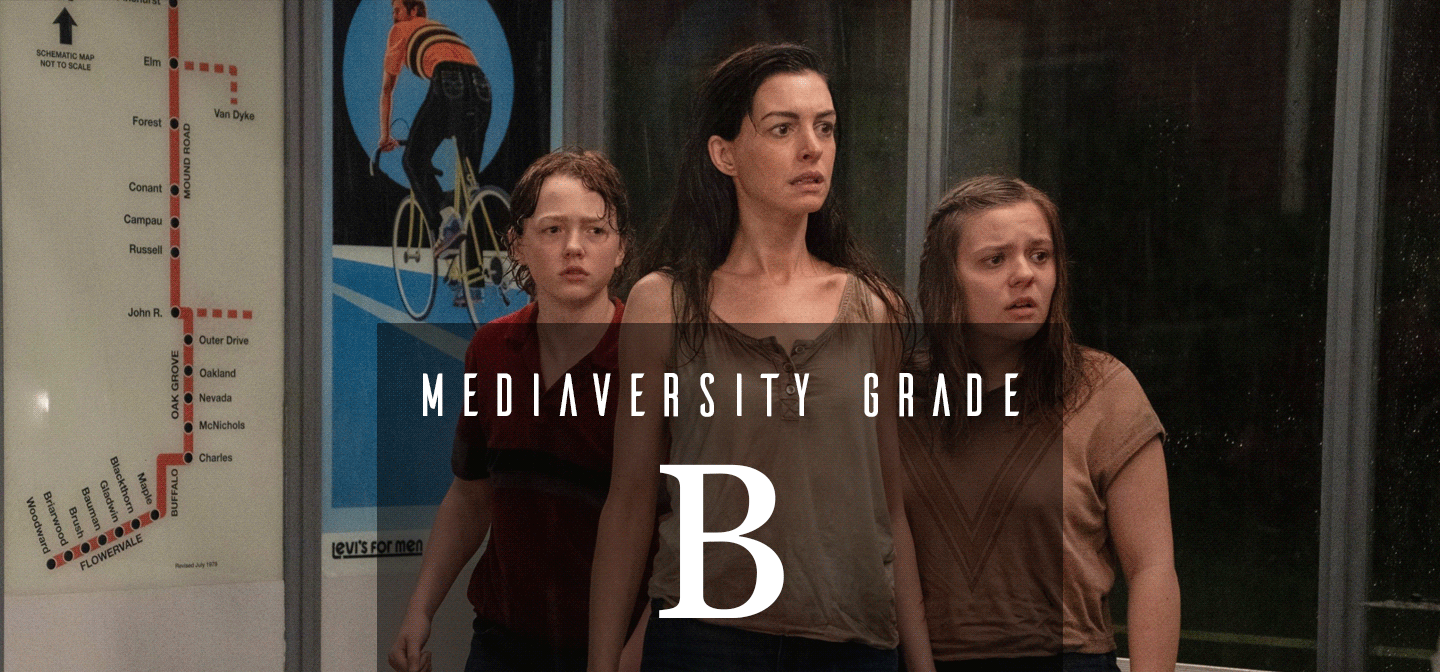
“The End of Oak Street gives nuanced, fully lived-in portraits of women in their 70s and older.”
Title: The End of Oak Street (2026)
Director: David Robert Mitchell 👨🏼🇺🇸
Writer: David Robert Mitchell 👨🏼🇺🇸
Reviewed by Jose Solís 👨🏽🇭🇳🌈
—MAJOR SPOILERS AHEAD—
Technical: 4.5/5
It’s 1982, and the Platts are just another family on Oak Street. Denise (Anne Hathaway), Greg (Ewan McGregor), and their kids Audrey (Maisy Stella) and Brian (Christian Convery) are living a life of “normal” dysfunction: Their marriage isn’t working, but Denise and Greg are trying to stay together for the kids. Then one morning, the whole neighborhood wakes up somewhere else. There’s no power or running water, and the milk is turning in the fridge. Oh, and the streets (and neighbors) have become an all-you-can-eat buffet for dinosaurs. Some families go to therapy to work through their issues … the Platts go through a wormhole, 65 million years back in time.
In The End of Oak Street, writer-director David Robert Mitchell shows off the same skills he deployed in It Follows (2014) by creating a stressful film that has you recoiling in your seat with hands over your eyes, then over your ears, and somehow having a great time doing it. The End of Oak Street recalls Steven Spielberg by way of horror, combining the childlike wonder of E.T. (1982)—complete with kids on bikes and creepy lights in the middle of the night—fused with the thrills of Jurassic Park (1993).
From the jump, the world-building is gorgeous. One camera move tells you everything about how Mitchell thinks: He holds on Denise mid-conversation with a neighbor, then lets the scene drift, almost absentmindedly, towards one of her kids, and we follow their path next. It’s a small gesture that conveys how every house on this street is its own planet, how each character could’ve been the lead, but that this family happens to be the one we’re following tonight. With this quotidian sensibility underpinning the supernatural events, The End of Oak Street gives every viewer a front door into the action.
Gender: 4.25/5
Does it pass the Bechdel Test? YES
Denise doesn’t stay in the passenger seat. During her years of marriage, she’s secretly written a book about a woman who leaves her family, and Greg isn’t supposed to know it exists. When their neighbor Mel Jacobs (P.J. Byrne) comes around complaining—again—about the Platts’ dog, Denise finally says what Greg’s always been too soft to say himself: She tells Mel she will burn his house down if he touches their pet, showing how she is more than the “nice lady” next door and has the kind of backbone necessary to lead her family through a dino-apocalypse.
It’s not just Denise who’s portrayed well. She seeks out older women in her neighborhood for advice on writing and Jurassic botany. When a strange plant shows up in the yard, she brings a photograph straight to Mrs. Valcourt (Emily Kuroda), the town librarian, because she knows Mrs. Valcourt can identify it. Mrs. Huddleston (Anne Gee Byrd) mentors Denise on her manuscript, revealing that she used to edit books for her husband and telling Denise to keep writing and dream beyond her current, narrow life.
Race: 2.75/5
Most of the neighborhood blurs into porch lights and lawn chairs regardless of who’s living behind them, but two exceptions in supporting roles stand out. Japanese American actor Kuroda, who spent seven years as the caustic but lovable Mrs. Kim on Gilmore Girls (2000–07), plays Mrs. Valcourt with shrewd gravitas. Jeannette Christiansen (Jordan Alexa Davis), the new girl next door and Brian’s crush, is warmly welcomed by the Platts and given real stakes once she’s the only survivor in her own family. Davis, who is Black, subverts the trope of getting killed off first. Instead, Jeannette makes it all the way to the end—a dignity that’s usually only afforded to white characters in a horror movie.
Bonus for Age: +0.75
Mrs. Huddleston (played by Byrd, who’s 88 at the time of this review) and Mrs. Valcourt (Kuroda, 73) aren’t just old ladies down the street. Denise purposely seeks out their hard-earned wisdom. It shouldn’t feel so rare that people in their 70s and older are respected for their minds, but it does—and this movie gets that very right. Furthermore, Mrs. Huddleston is amongst the first people Denise checks in on after she realizes what’s happened to their neighborhood, emphasizing Mrs. Huddleston’s worth as a human being, not just a source of advice to be used and discarded.
Bonus for Religion: +0.25
Jeannette’s Catholic school background surfaces once, briefly, in a conversation about faith that could’ve been a throwaway line. Instead, it plays as a genuine, meditative break amid relentless action.
Mediaversity Grade: B 4.17/5
The End of Oak Street is summer action at its best, delivering stunning dinosaur sequences anchored by great work from Hathaway and McGregor. It also does something the genre rarely bothers with: Mitchell gives nuanced, fully lived-in portraits of older women, and real stakes for at least one character of color beyond the central white family. It ends on a note of hope, too, leaving audiences both moved and entertained.
Like The End of Oak Street? Try these other dystopian titles that are also touching.

Bumblebee (2018)

The Wild Robot (2024)

Finch (2021)