
Finding Emily
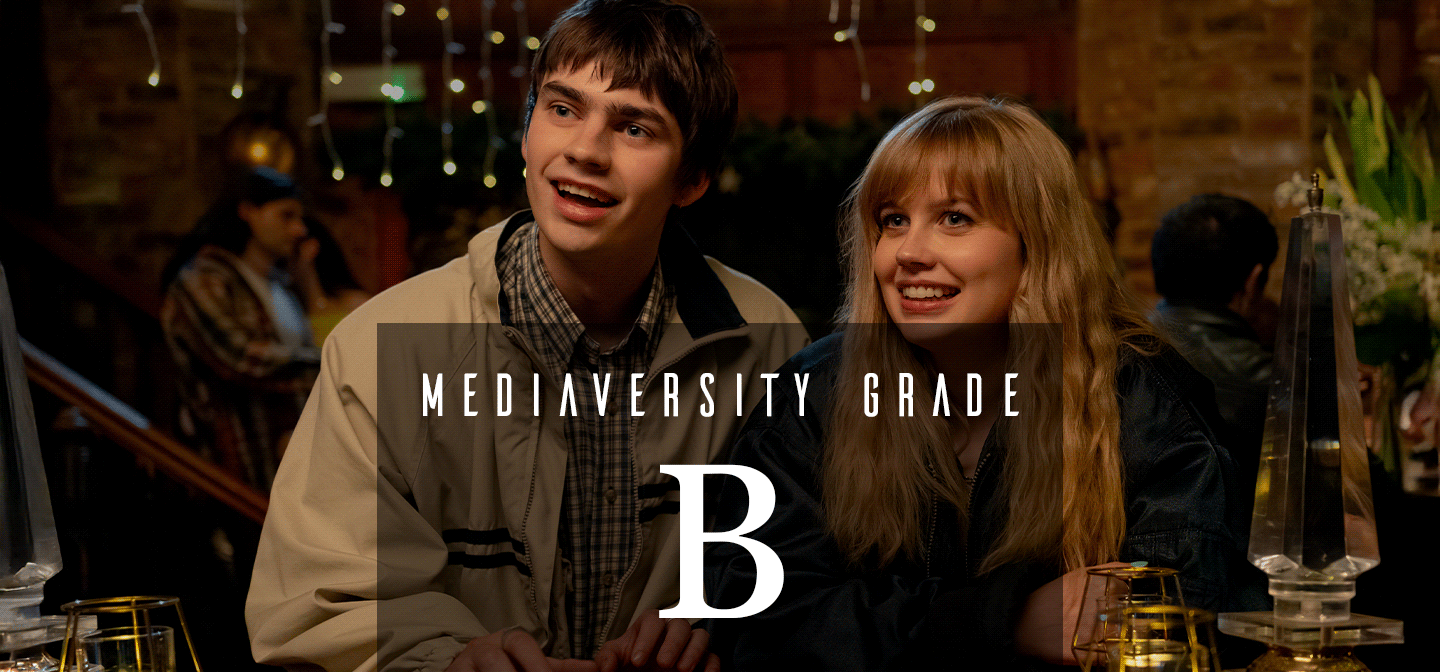
“All the Millennial graduates of indie sleaze will be knocking down the door to join Finding Emily on the dance floor.”
Title: Finding Emily (2026)
Director: Alicia MacDonald 👩🏼🇬🇧
Writer: Rachel Hirons 👩🏼🇬🇧
Reviewed by Li 👩🏻🇺🇸
Technical: 4/5
Finding Emily opens on New Order’s distinctive “Blue Monday” synth, skywriting its aim to be a Manchester-set crowd-pleaser from the jump. Add in a Yeah Yeah Yeahs remix here, some Scissor Sisters there, and lo and behold, all the Millennial graduates of indie sleaze will be knocking down the door to join main characters Owen (Spike Fearn) and Emily (Angourie Rice) on the dance floor.
More than just a nostalgia play, though, Finding Emily’s needle drops give this rom-com a pulse. Without them, there’s admittedly not a whole lot here: Owen meets a girl at a club, knows only her name “Emily” and gets her phone number one digit short, then enlists an American psychology student—another Emily—to help him find her. Little does Owen know, American Emily is quietly making him the case study for her thesis arguing against love. The mechanics are visible from a mile off, as telegraphed and, depending on your mileage, as comforting as a Hallmark Christmas movie.
Luckily, the young leads are likable enough to keep the pacing breezy, while supporting characters like a fellow uni student, Kyle (Anthony J. Abraham), and Emily’s psych professor, Westlake (Prasanna Puwanarajah), have great comedic timing that had my theater chuckling along. Others—Emily’s roommate, Anna (Cora Kirk), and Owen’s brother Matt (Jack Riddiford) and sister-in-law Freya (Isabella Laughland)—flesh out the cast and give our star-crossed leads much-needed support as they bumble their way through the film.
Finding Emily’s weakness is also predictable: plot holes. Director Alicia MacDonald and writer Rachel Hirons don’t seem overly concerned about the details. At one point, Owen scales a drainpipe to break into Emily’s flat, and the film never shows him trying the obvious thing first—texting or calling her. Another point of confusion is whether Emily has sabotaged her own internship in the name of lurve. How is she supposed to live happily ever after with Owen if Emily’s work visa is rejected and she has to go back to Iowa? Not the point, I know. But if you can ignore the pesky voice inside you saying “make it make sense,” it’s a lot easier to enjoy the easy humor and catchy beats in this appealing story.
Gender: 4/5
Does it pass the Bechdel Test? YES
With MacDonald directing and Hirons writing, the film has women shaping it at the top. This shows in the lovely portrayal of female friendship between Emily and her roommate. In one of the film’s most heartwarming scenes, Anna pesters Emily out of a depressive funk by putting on some furious music and dancing up on her until couch-burrito-Emily starts to flail and rage-dance along with Anna.
Alas, Emily’s arc still revolves around a man—and, as an unintentional byproduct, it implies that a career won’t make her as happy as a man will. Some two-dimensional caricatures also hang around. The university’s campus activist is portrayed as a hysterical feminist who organizes protests that villainize Owen, and Laura Lewis (Nadia Parkes) is a predatory podcast host who chases engagement rather than fairness. It’s not the worst—boys like Emily’s ex, Tristan (Timothy Innes), are also flimsily written. But as far as female representation goes, fresher rom-coms, such as last year’s Jane Austen Wrecked My Life, have found elegant ways to center a woman and her growth within the context of a male-female romance.
Race: 3.5/5
Finding Emily has white leads, and characters of color fill out the supporting cast. It’s important that the latter are there—Manchester is hugely diverse, with Asian, Black, and multiracial residents making up almost 40% of the entire population. So the numbers look fine, but it’s still notable that the people of color here exist in relation to the white leads.
As far as their portrayals, at least they aren’t sycophantic. Characters like Anna (played by Kirk, who’s multiracial), Professor Westlake (Puwanarajah, Tamil Sri Lankan), and Freya (Laughland, white and Indo-Guyanese) seem to have their own lives, jobs, and social worlds that continue offscreen. But the film is wholly invested in its white leads—whose other love interests, Emily’s Tristan and Owen’s missed connection, are also white.
Bonus for LGBTQ: +0.25
Queer characters don’t have main roles, but they’re naturally woven into the storyline through gay bars, a drag performance, and supporting characters like student Rhea (Amber Grappy), the bartender at the club where Owen met his original “Emily.” Rhea wears a tee emblazoned with "I Kiss Girls" and has a female love interest. The two dance and show up together in a few different scenes, ensuring that Rhea isn't tokenized.
Owen’s presence in queer spaces is also worth crediting. He doesn’t flinch, act awkward, or become the butt of any gay-panic gags. He rolls with it and takes some light barbs on the chin, and the film treats that as unremarkable—itself a small argument.
Mediaversity Grade: B 3.92/5
Finding Emily is peppy, funny, and cute as hell. The soundtrack stands out more than the script, and the whole thing arrives exactly where you expect it to. While not exactly fresh on the inclusion front, it’s warm enough that you can still enjoy it guilt-free.
Like Finding Emily? Try these other titles with romantic tropes.

To All the Boys I’ve Loved Before (2018)

Sierra Burgess is a Loser (2018)

The Half of It (2020)