
American Fabric
“American Fabric centers voices we rarely see, as Pakistani American women make their own choices about wearing hijab.”
Title: American Fabric (2026)
Runtime: 13 minutes
Director: Nyla Hazratjee 👩🏽🇵🇰🇺🇸
Writer: Nyla Hazratjee 👩🏽🇵🇰🇺🇸
Reviewed by Jose Solís 👨🏽🇭🇳🌈
Note: This review was commissioned. The content and methodology remain 100% independent and in line with Mediaversity’s non-commissioned reviews.
Technical: 3.5/5
In the 13-minute short film American Fabric, writer-director Nyla Hazratjee follows two young Pakistani American women who are moving in opposite directions when it comes to wearing the hijab. Lina (Hana Aisha), a model, decides to put one on, while university student Nila (Carina Conti) decides to take hers off. The film builds their stories as mirror images, such as brushing past each other when one leaves a mosque without her hijab, the other just about to put one on. They don’t notice each other at first, but then they meet at a Fourth of July party.
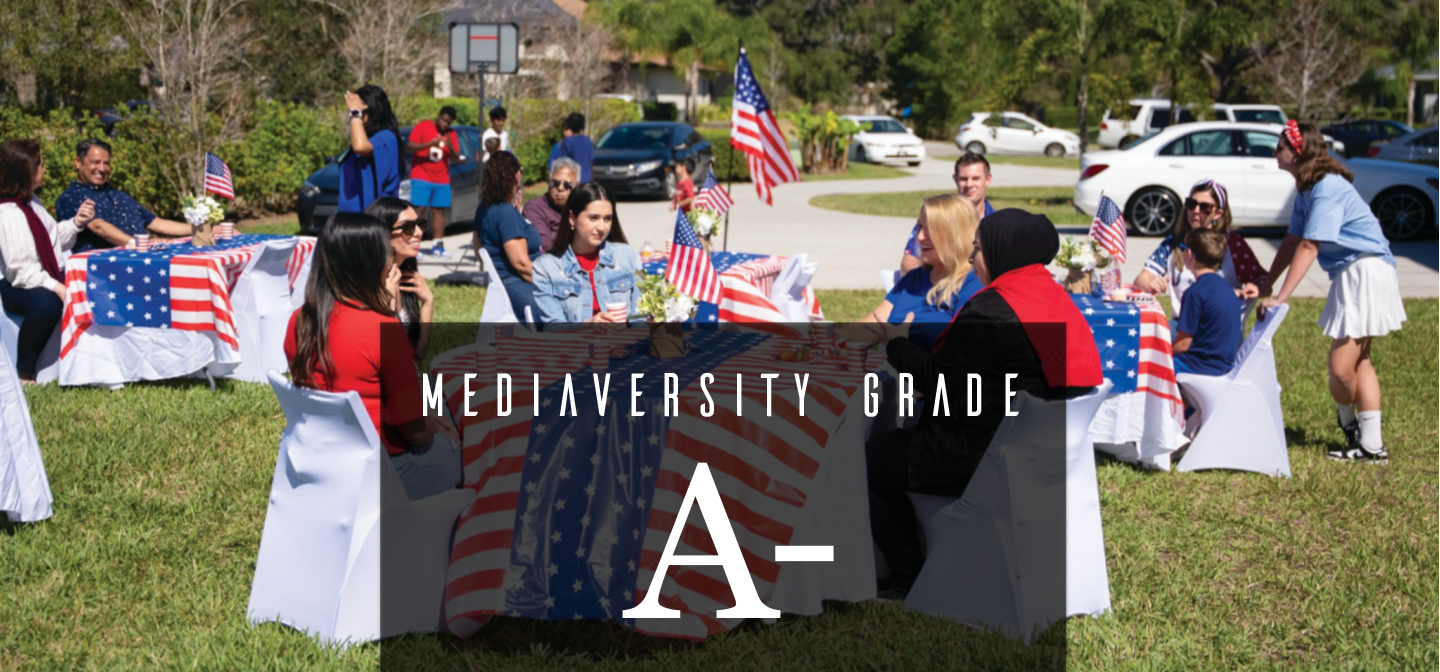
With so little time, Hazratjee tells her story through images that strike a note. From the opening scenes, we meet Lina at a photo shoot wearing an American flag swimsuit and draped in a stars-and-stripes-printed shawl. It’s a sign that she belongs in the country, as well as a veiled reminder of what she's expected to wear to prove it. The visual theme returns later, seen all over the Fourth of July barbecue. Cinematographer Tian Liu's compositions pack each frame with clues about who these people are, and the production design makes every home feel specific and lived in. The film also contrasts the stifling indoors against the more freeing outdoors, as Lina and Nila leave the party to take a breather on a small dock by the water.
The editing is tight and the storytelling economical, catching passing comments that wound both women. Aisha and Conti carry the doubt and hurt of their choices to wear (or not to wear) hijab without cracking in front of anyone. At times, though, the raw-edged American Fabric feels like a proof of concept for a longer film. But that's as much a compliment as a limitation.
Gender: 5/5
Does it pass the Bechdel Test? YES
Hazratjee gives Lina and Nila similar screen time and lets us understand each woman’s motivations. Lina seems tired of being reduced to her looks and hearing the hijab being criticized. In one scene, she suggests to her makeup artist that "tradition can be comforting." (He all but rolls his eyes.)
Meanwhile, at the University of South Florida, hijab-wearing student Nila finds inspiration in a lecturer (Maytha Alhassen), whose speech about freedom makes Nila think of possibilities she didn't know she had. Neither main character becomes a mere symbol, though. The complex performances suggest that there's more behind Nila and Lina’s decisions than the short runtime lets us see. Despite others’ shady comments and unsolicited suggestions about what they should be wearing, the two female leads stand firm.
The film also shows how men objectify women whether or not they wear a hijab. The photographer at Lina's shoot sees only her body and makes gross innuendo, while two white men sitting behind Nila call her and her friends "fucking towel heads"—then add that they'd still sleep with them. Even the women around Nila and Lina objectify them; Lina gets asked if she's hiding weight gain or trying to impress boys, and how she'll make a living as a model if she can't show off her hair for shampoo ads. Her mother (Claudia Balthazar) warns that "normal men" won't want a woman in a hijab, saying "we left that behind," hinting at a migration story we never get to hear.
In the film’s climax, Lina and Nila finally meet and instantly bond, both trying to escape the many eyes that judge them at the Fourth of July party. It's just the beginning of a conversation rather than a full exchange, but it still makes an impact. Behind the camera, Hazratjee wrote, directed and produced the film with a crew made up mostly of women.
Race: 4.5/5
Both heroines are Pakistani American, as confirmed by American Fabric’s press notes, but the barbecue scene brings together a racially and ethnically diverse community. Black children run around the yard, and white guests take pictures—an idealized vision of America, perhaps. There isn’t much room for nuance in this film, but seeing various characters of color adds a lived-in quality.
Bonus for Religion: +1.00
American Fabric, captures the particular brand of prejudice that Muslim Americans face, from strangers' slurs to Lina's little brother (Isa Ahmed) asking her not to pick him up from school in a hijab. Islam sits at the center of the plot, and the film treats faith as a lived and personal experience rather than as shorthand for a grander message. For example, the mosque becomes a place where Nila finds permission in her own spirituality to take off the hijab. It’s a nuanced take that stands out for its authenticity.
Deduction for LGBTQ: -0.25
The white male makeup artist (John Alan Dalton) at Lina's photo shoot is implied to be gay through his mannerisms and speech. He has no depth, slipping into cliché as a “sassy” makeup artist.
Mediaversity Grade: A- 4.58/5
American Fabric gives two young Muslim American women the right to define themselves. Though its short runtime leaves its world sketched rather than fully explored, Hazratjee centers voices we rarely see, as Pakistani American women make their own choices on screen.
For more information on American Fabric, see the NY/LA Production website or Instagram @nylaproductionorg.
Like American Fabric? Try these other films that center on South Asian women.

Ms. Marvel
A Diwali Dilemma (2025)

Love Chaos Kin (2026)