
Everybody to Kenmure Street

“Everybody to Kenmure Street emphasizes collectivism, with many white neighbors joining in and helping to protect the Sikh detainees.”
Title: Everybody to Kenmure Street (2026)
Director: Felipe Bustos Sierra 👨🏽🇧🇪🏴
Producer: Ciara Barry 👩🏼🇬🇧🏴
Reviewed by Li 👩🏻🇺🇸
Technical: 4/5
Earlier this evening, Everybody to Kenmure Street premiered at Sundance Film Festival. Directed by Felipe Bustos Sierra, the documentary charts the 2021 events in Pollokshields, Glasgow, when a UK Home Office dawn raid triggered hundreds of residents to rush to Kenmure Street to stop the deportation of two Sikh residents.
Sierra uses a simple but engrossing approach to illuminate this uplifting story. The chronological narrative embroils viewers into the action, as neighbors become aware, then increasingly concerned, about the detention of their neighbors. The story marches forward in a straight line, broken only by a long interlude that sheds light on the history of Glaswegian resistance.
This diversion is helpful at first, prolonging the delicious tension of the film’s main story by pausing to ground it in social context. But the far-flung topics wander between 17th-century slavery, Nelson Mandela’s 1993 speech, the Glasgow Girls campaign, and the neighboring Govanhill Baths sit-in. The Kenmure Street protests themselves create a propulsive watch without the need for so much editorializing. Luckily, Sierra generally uses a light touch and allows the powerful story to tell itself through the interview subjects who were there firsthand.
Gender: 4/5
Does it pass the Bechdel Test? YES
Gender isn’t a focus, but interviewees are balanced. Key female figures include a nurse—portrayed by one of the film’s executive producers, Emma Thompson—who provides support throughout the 8-hour-long resistance. Activist Tabassum Niamat appears on screen for several clips, describing her crucial role as a front-row livestreamer, as does politician Roza Salih, one of the “Glasgow Girls” who stood up for their asylum-seeking classmate in 2005. Men have comparable screen time, and it’s indeed a man, lawyer Aamer Anwar, who negotiates with Police Scotland to finalize the detainees’ release. But Everybody to Kenmure Street capably includes the women who were integral to the protest’s success.
Race: 4.25/5
Racial identity isn’t explored in depth. But because the film spotlights the diverse neighborhood of Pollokshields, those involved span Pakistani, Iraqi-Kurdish, Afghan, and other ethnicities. The documentary also goes over Glasgow’s part in the Transatlantic Slave Trade and sets the UK’s anti-immigration policies in a broader historical context.
That being said, the documentary emphasizes collectivism, with many white neighbors joining in and helping to protect the Punjabi detainees. This is a wonderful story of Scottish triumph and allyship, but the fact that people of color are centered feels more incidental than by design.
Bonus for Religion: +0.50
In addition to racial and ethnic diversity, key subjects come from different religious backgrounds. Though not always mentioned in the documentary itself, the two detainees are Sikh, and several interview subjects are Muslim. The dawn raid also pointedly took place on Eid al-Fitr, making religion a throughline. A nearby mosque on Kenmure Street is mentioned often, with people coming out after Eid prayer describing their surprise at seeing the chaos on the street. Later, the mosque becomes an unconventional place for truce as police officers and protesters share bathrooms, then head back into the streets to face off.
Mediaversity Grade: B+ 4.25/5
Everybody to Kenmure Street celebrates the power of collective resistance in this moving, hopeful documentary. But in reality, anti-immigrant policies march on, making this a complicated tale—one that’s still ongoing in newspapers and on TV and social media. Niamat and co-writer Pinar Aksu detail the discouraging aftermath here, while across the pond, the United States is openly waging war against its own residents. It’s a tough time for immigrants in many places, and I can only hope that more outcomes like the one seen on Kenmure Street can prevail.
Like Everybody to Kenmure Street? Try these other titles starring Muslims.
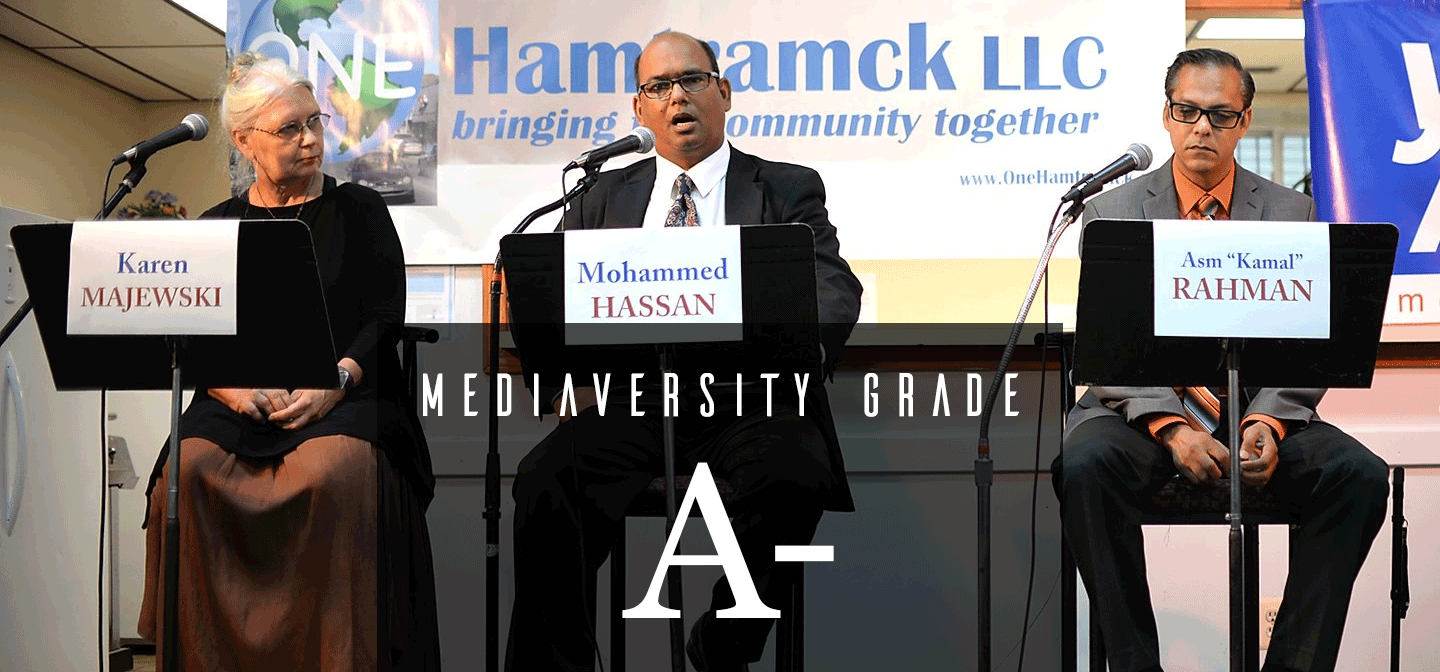
Hamtramck, USA (2020)

Ms. Marvel

Atlantics (2019)