
At the Sea

“It's a shame that At the Sea is more interested in Laura’s relationships with men than in herself.”
Title: At the Sea (2026)
Director: Kornél Mundruczó 👨🏻🇭🇺
Writer: Kata Wéber 👩🏼🇭🇺
Reviewed by Sarah Manvel 👩🏼🇮🇪🇺🇲🌈
Technical: 3/5
Kornél Mundruczó and Kata Wéber, a husband-wife duo, made their names with award-winning movies about modern life in Hungary, such as Delta (2008) and White God (2014). Their latest film, At the Sea, takes a different route and takes place in Cape Cod, Massachusetts.
The film concerns the overlapping worlds of modern art and philanthropy: Laura (Amy Adams) inherited her late father’s dance company and is responsible for 100 jobs, but her billionaire friend George (Rainn Wilson) is the one footing the bills—and who, therefore, feels entitled to call the shots. When the movie opens, Laura is returning home from a stay at rehab for alcoholism, determined to go public about her addiction, and wanting to walk away from her father’s company for a fresh start. But that plan puts her in direct conflict with both George and her controlling husband, Martin (Murray Bartlett).
Interesting as the premise is, At the Sea doesn’t stick the landing. The clunky title alone suggests that Mundruczó and Wéber are working in a second language, and that awkwardness extends into the film itself. For example, it teases Laura’s troubled relationships with Martin and their children—older teen Josie (Chloe East) and 9-year-old Felix (Redding L. Munsell). But rather than delving into those pressing issues, the film focuses on Laura’s childhood memories of her father (Pál Frenák) and how he’s shaped her life. In another odd choice, a subplot involves the notable English actor Brett Goldstein (Ted Lasso, Shrinking) as a sober kite seller, but he’s hastily introduced, and the storyline is never resolved. At the Sea tries to tackle ambitious themes, but the clumsy execution doesn’t sit right.
Gender: 2/5
Does it pass the Bechdel Test? YES
A brief conversation between Laura and her friend Debbie (Jenny Slate) ensures that At the Sea at least passes the Bechdel test, but their friendship feels superficial. The film also relies on worn clichés about parenting and gender roles: While Laura was away, Martin focused on his career, leaving Josie to parent her younger brother. But when Laura’s back, all she and Martin can see is Josie’s anger and misbehavior, never considering their own mistakes as parents who put the burden of childcare on a teen girl.
Finally, At the Sea features constant flashbacks to Laura as a child with her father, but confusingly, we never see her mother. It’s a major omission that feels both confusing and gendered.
Race: 1.5/5
Only three people of colour have brief speaking parts: a doctor at rehab, Josie’s friend, and a woman at a party. None has any character development.
Bonus for Age: +0.25
Except for the children, characters are mostly in their 40s and older. The lead actors, Adams and Bartlett, are in their fifties. But they don’t actively counter stereotypes: Laura is desexualized after she returns from rehab and is surprised to find out that Josie is sexually active. This falls into Hollywood norms of only showing women as sexually viable in their younger years.
Bonus for LGBTQ: +0.25
Dan Levy’s character is gay but underdeveloped. There’s also a brief reference to Laura’s father sleeping with his male and female dancers to manipulate their performances, which falls into the bisexual stereotype of being untrustworthy or promiscuous.
Mediaversity Grade: D 2.33/5
At the Sea depicts a woman trying to wrest control of her life from addiction. It’s a shame, then, that the film is more interested in her relationships with the men around her than in herself.
Like At the Sea? Try these other titles starring Amy Adams.
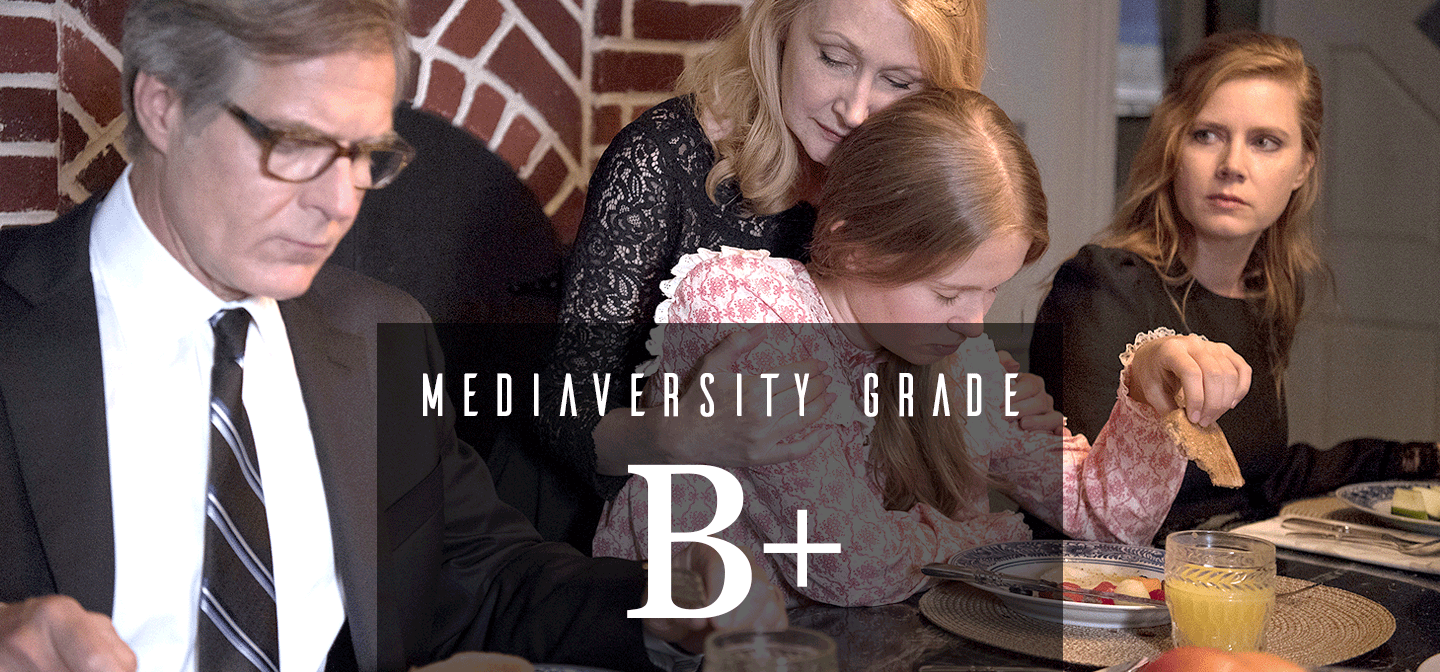
Sharp Objects

Arrival (2016)

Vice (2018)