
Normal
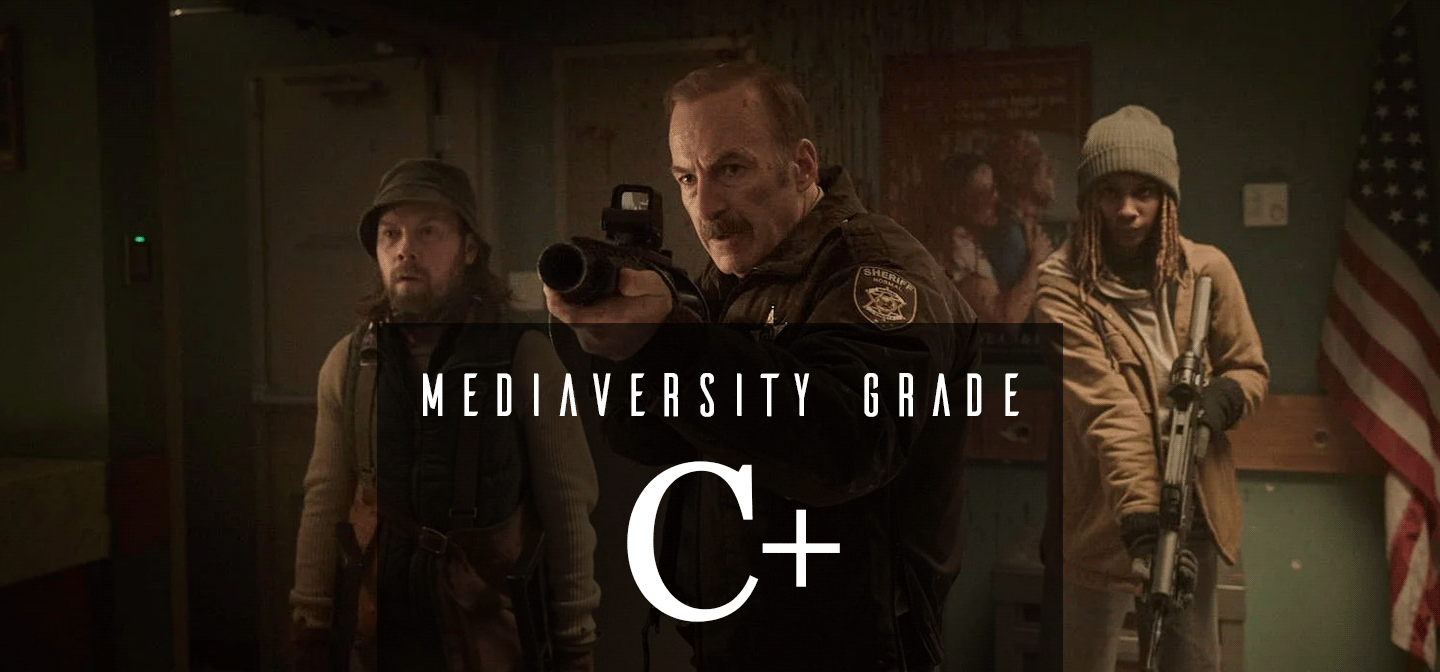
“Normal swings wildly from fun genre tropes to tired Asian stereotypes, to a surprisingly sensitive nonbinary story.”
Title: Normal (2026)
Director: Ben Wheatley 👨🏼🏴
Writer: Derek Kolstad 👨🏼🇺🇸
Reviewed by Li 👩🏻🇺🇸
—MAJOR SPOILERS AHEAD—
Technical: 3.25/5
Ben Wheatley’s black comedy shoot-em-up, Normal, stars Bob Odenkirk as a sheriff who’s been temporarily assigned to the town of Normal, Minnesota, where he gets embroiled in local, deadly secrets. Odenkirk’s sardonic Ulysses grounds the otherwise flimsy flick, lending gravitas to comical scenes. When a bank robbery goes off the rails, Ulysses acts like the eye of the storm, maintaining calm as a man suffers a heart attack and bullets fly overhead.
It’s a great dynamic that Odenkirk upholds throughout the chaos. Though Normal is ultimately forgettable—just breezy enough at 90 minutes to be lots of fun but not that deep—Wheatley’s action solidly entertains. Meanwhile, creative plot twists and characters who contain multitudes elevate this movie above the graveyard of bland, lackluster action movies.
Gender: 3.25/5
Does it pass the Bechdel Test? NOPE
Ulysses picks up a couple of allies during the film’s descent into total carnage. Among them, the former Sheriff Gunderston’s (Pat Harris) child, Alex, is trans and nonbinary, much like their actor Jess McLeod. Alex has a great role that’s about as fleshed out as it gets in this light film. In secondary roles, out-of-towner Lori (Reena Jolly) also teams up with Ulysses. She’s capable and kind, if morally gray. (She, along with her partner, is one of the aforementioned bank robbers.) In addition, Moira (Lena Heady) owns a bar and listens to Ulysses’ painful past with empathy.
After that, though, the film is dominated by men in supporting roles. Minor characters especially skew strongly male. A few women pick up guns and makeshift weapons to join in on the film’s central melee, but crowd shots of townspeople are confusingly male-centric. Where are the women? Did they all stay home?
Beyond what’s visible, women’s roles fall into a couple of clichés. The only people Ulysses mentions from his past are his estranged wife, Penny, and a girl who was being sexually assaulted under Ulysses’ watch as sheriff. Both plot points use women’s emotional pain and victimization to build up the male lead’s sob story.
Race: 2.5/5
When it comes to racial representation, Normal presents a mixed bag. From the get-go, viewers are forced to watch an Osaka-set scene of yakuza doing stereotypical things: prostrating themselves to a mob boss, slicing off their own fingers, cowering, being beheaded by katana, and getting covered in blood with their eyes bulging. If only it ended there, but alas. The rest of the film treats every Asian person as an accented foreigner—all of them yakuza, and by the film’s end, all of them dead. The sole exception in a minor role is bank teller Pat, played by Filipino Canadian Alan Castanaga, who has one line (“Nobody uses cash anymore!”). It’s so depressing that another Canadian actor, Montreal-born Peter Shinkoda, is forced to adopt a fake Japanese accent just to get cast in this movie. Venerable Asian American actors, like Cary-Hiroyuki Tagawa (Mortal Kombat) and James Hong (Big Trouble in Little China), deserve better legacies. They already had to put up with being typecast as accented villains in the 1980s. Why are we doing the same to Shinkoda today?
On the more positive side, the cast is fairly diverse. Normal’s townspeople are still slightly majority white, but brief scenes show Black people doing everyday things, and Lori—played by Jolly, who’s Caribbean Canadian—has an important role. Lori begins on uneven footing as someone trying to hold up a bank, but she develops into a more well-rounded protagonist after joining up with Ulysses.
Similarly, when we meet deputy sheriff Blaine (Ryan Allen, Black Canadian), we instantly recognize this character: the buffoonish officer who wants the sheriff’s badge for himself but lacks the skill to deserve it. But over the course of the film, Blaine reveals layers, speaking Japanese to the yakuza once they’re in town (if only knowing a few rudimentary lines, which he acknowledges himself), and eventually earning Ulysses’ respect. Importantly, he’s one of the few survivors to make it to the end of the movie—a nice subversion of the Black Guy Dies First trope.
Bonus for LGBTQ: +0.75
While Normal’s main character remains a straight dude, the film seamlessly features a trans/nonbinary character, Alex, who’s thoughtfully introduced and developed.
We first hear of Alex through the rumor mill, where characters like the villainous Mayor Kibner (Henry Winkler) describe them as “Gunderston’s daughter.” Then Ulysses meets Alex in person, and a tasteful exchange ensues. Ulysses mistakenly asks, “You’re Gunderston’s daughter, right?”, to which Alex scoffs and replies with a clipped “No.” At that point, Ulysses easily backtracks and says, “Oh, yeah, okay. You’re Gunderston’s kid?”
This simple course-correction sets a great example of how gender identity doesn’t have to be full of jargon or labels, and that it’s okay to make mistakes as long as you’re trying to treat LGBTQ people with respect. Ulysses unknowingly misgenders Alex, but then he fixes it and moves on.
And Normal doesn’t stop at just simple inclusive casting; rather, Alex’s background as a queer kid in a “small-minded” town (as Moira puts it) becomes an integral part of the plot. Audiences learn that the mayor forced Gunderston to choose between Alex and the town, and Gunderston chose his child, with grave consequences. It sets up the town’s dark past, and in the action genre where dead moms and girlfriends are a dime a dozen, Normal flips the script by using a father’s murder to supply the motivation for a nonbinary character’s emotional journey. Love to see it.
Mediaversity Grade: C+ 3.25/5
Wheatley’s Normal swings wildly from fun genre tropes (the whole town against a few mavericks!) to tired Asian stereotypes, to a surprisingly sensitive nonbinary story. It all averages out to something enjoyable to watch, but not especially groundbreaking in any one area.
Like Normal? Try these other conspiracy flicks full of death and murder.
Monkey Man (2024)
John Wick: Chapter 3 – Parabellum (2019)
Knives Out (2019)